Restoring plants in a burn scar evokes both grief and gratitude…

A few weeks ago I drove to the Grand Canyon’s North Rim. When I stopped for coffee on the way out of town, I bumped into the director of the Flagstaff Dark Skies Coalition, a nonprofit whose goal is to make the Milky Way visible to everyone in the world. Ambitious, yes, but also entirely achievable. Light pollution, unlike other kinds of ecological damage, is quick to reverse: just turn off the lights. (More specifically, change them to amber-colored, shielded fixtures).
So the Milky Way was on my mind when I arrived at the campsite and met up with a group of volunteers working to restore native vegetation on the Dragon Bravo fire scar. Reversing fire damage isn’t so quick. In the spots where the Dragon Bravo burned intensely, it seared the soil and destroyed the seed banks. Still, my time in the park left me hopeful. Young aspens pushed up through stands of dead pines, and the meadows were bright with lupine, yarrow, and fireweed.
Nature is resilient and fire is healthy. It’s hard to keep that in mind in this age of megafire – particularly when fires destroy places we love, like the historic lodge on the North Rim and the visitor center that kept my book on its shelves. Susan Tweit, in Bless the Birds, writes of the challenge of “holding gratitude for the gift of what we’re losing.” She was speaking of her husband’s death but the words also apply to the land. How do we remain grateful for canyons and rivers, ravens and deer, while also holding onto the endless grief of ecological loss? How do we remember the Milky Way is still there, even in places where it can’t be seen?
So much depends on the frame. Here’s one photo I took on the Dragon Bravo scar:
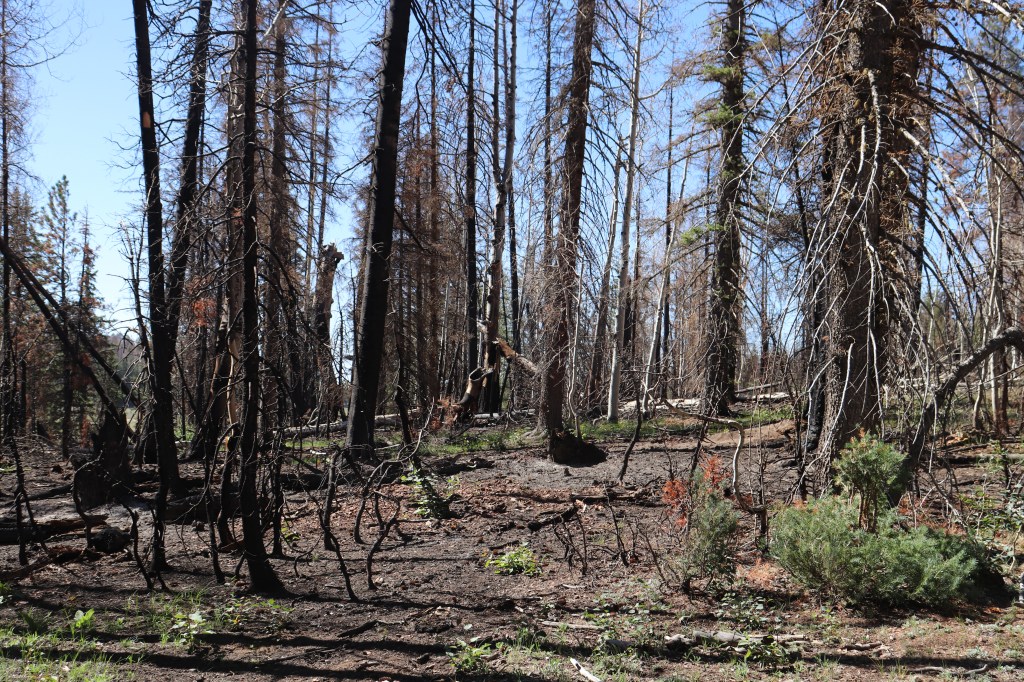
But turning the camera lens without moving my feet, here’s another view:

Grief and gratitude. Holding both at the same time isn’t easy, but it’s also the place from which we can do real work in the world. It’s how we see a problem without becoming overwhelmed by it. It’s how we act in small ways, without feeling that “small” equates to “meaningless.”
The small acts of the North Rim volunteer group, which was organized by the Grand Canyon Trust, were planting pine seedlings, gathering lupine seeds, and weeding nonnative mullein in the fire scar. Of course, nature does not favor lupine over mullein. That’s a human judgement. Behind it, I think, is a desire to heal what we’ve harmed, which is not a bad principle to guide our choices.
Environmentalism has long focused on the gospel of overconsumption: too many people, too many wants. It’s come to trouble me. As an adult I’m unlearning the ingrained lessons of childhood, which were to stay quiet, don’t make demands, be content with what you have. I’m learning it’s okay to be loud, take up space, express my desires. Maybe it’s useful to change the frame: to think of our needs and wants, not as too much for the world, but as out of step. Eleven Tribes have ties to the Grand Canyon; when they, and their ancestors, practiced cultural burning, they were doing what was best for themselves and the land. There was no distinction.
In the face of megafires and climate change, grief sometimes overwhelms my ability to act, to re-seek a right rhythm with the place where I live. Artificial light sometimes shrouds the stars. But time spent afield in the wild world, again and again, rouses me to awe. On the North Rim, the waning moon was less than a quarter full, but still bright enough to wake me each time it rose. Each time, I was astonished anew by the white band of the Milky Way, ever constant and endlessly new.
It’s a new moon tonight, friends. Go out and look at the stars.
More reading
Want more? I wrote about the North Rim fires for The Advocate.
On the topic of plant restoration, here’s my High Country News story about the botanists restoring rare orchids to an Arizona wetland.
Am I blogging now? I don’t know. Subscribe and find out! You can also find these posts on Substack.

 Melissa L. Sevigny